
Texas, private property
Dead Animal Under the House or Deck in Texas
The animal is under something: the back deck, the front porch steps, a storage shed on blocks, or a pier-and-beam house with skirting. You can usually smell it before you see it, and a flashlight through the gap often finds it. The question is whether that gap, or an existing access panel, is wide enough to work through. If it is, the request is one an independent operator can take where one covers the address.
Who removes a dead animal from under a house or deck in Texas?
The one Texas city source on file that speaks to this says its crews do not go there. Austin Resource Recovery's own 311 close-out notes, written by staff on individual tickets, say the department does not collect animals from inside or under any buildings or decks, that technicians cannot crawl under decking, and that an animal must be completely clear of obstructions before a crew can take it. The same notes describe a yard pickup as a last resort for an animal too large to move, with someone at home.
Every other city and county page we reviewed is silent on the point. Dallas Sanitation's page describes collection from City rights-of-way and from the curb on request and does not mention anything under a structure. Harris County Precinct 4's FAQ and the Montgomery County precinct pages describe county road and right-of-way work and do not mention it either.
That leaves the private route. An independent operator can lift a carcass out through the gap or access opening the deck or house already has, with every finished wall, ceiling and floor left intact. Calls reach this site's routing line; form requests are matched by ZIP code to an operator where one covers the address.
Source: Austin Resource Recovery, 311 close-out notes (Open311), checked 2026-11-24.
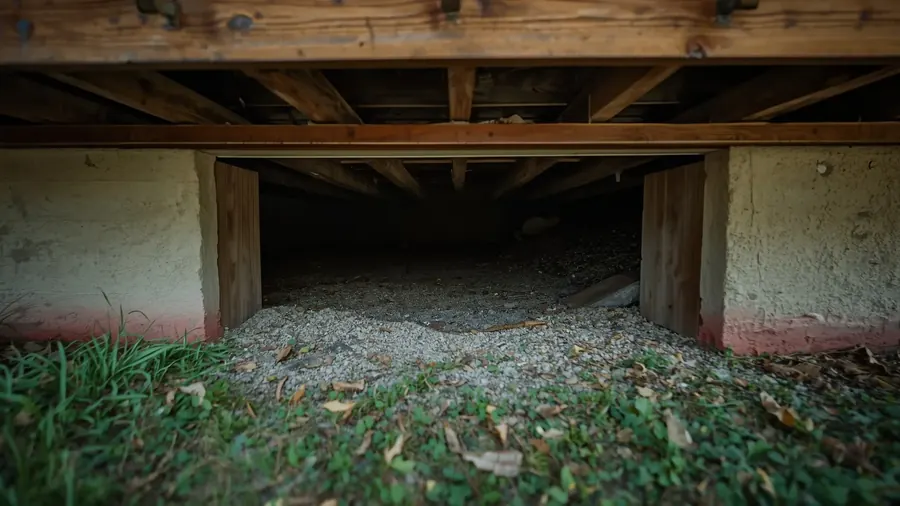
Can it be reached through the gap the structure already has? Get low with a flashlight and look along the ground line. A deck with an open side, lattice that lifts off, a porch with a gap under the bottom step, or skirting with an access panel gives an operator a way in. A deck boxed in on all four sides with screwed-down boards does not, and nobody is sent to pry those up. Note how far under the carcass lies and whether the ground there is dry, muddy or under water. Then rule out the two cases this site does not route: an animal still alive, and any bite or scratch, which Health and Safety Code §826.041(a) requires to be reported to the local rabies control authority.
Cases this page is for
- A raccoon under the back steps, visible with a flashlight through the open side of the deck.
- An opossum that died behind the lattice skirt of a front porch, where one panel lifts off.
- A skunk under a storage shed set on blocks, with a clear line of sight from one end.
- A cat-sized carcass under a pier-and-beam house, reached through the existing skirting access panel.
- An armadillo that died under a low wooden walkway with an open side.
What falls outside it
A live animal under the deck is not routed, and Texas's statewide rabies quarantine makes it illegal to transport any live fox, skunk, coyote or raccoon (25 TAC §169.34). A deck or porch closed in on every side, with no panel and no gap, is not opened by anyone sent from this site; the carcass is information only until an opening exists, and the wall article explains that case. Nobody is sent to repair skirting, replace boards, work on the ground under the house, or look for how the animal got in. The remains of pets and livestock are not routed through this site.
The rule under a structure is the same as everywhere else on this site: the carcass must be reachable through an opening the house or deck already has, and every finished wall, ceiling and floor stays intact. Lattice that lifts off counts. A loose board the owner has already taken up counts. A board the operator would have to cut does not.
A deer rarely fits under a deck, but a heavy raccoon or a large opossum can lie far back under one. Weight changes how many people and what equipment the operator brings, and that is agreed with the operator when the visit is set. Nothing is kept.
How does an under-structure request move?
- Call the routing line, or send the form with the ZIP code and a line on which structure the animal is under and how it can be reached.
- A form request is matched by ZIP code to an independent operator where one covers the address. A call reaches the routing line.
- The operator asks about the gap or panel, agrees the price and the visit with you, and comes with a light and the gear to reach it.
- The carcass is pulled out through the existing opening, bagged and taken for disposal.
About this situation
Can the city collect a dead animal from under my deck?
Austin's own records say its crews do not. Austin Resource Recovery's 311 close-out notes say the department does not collect animals from inside or under any buildings or decks, and that technicians cannot crawl under decking. For other cities and counties, the pages we reviewed describe curb, right-of-way and county road work and do not mention anything under a structure. That is a description of the pages; it is not a statement that any of those agencies excludes the work.
How does an operator get a carcass out from under a pier-and-beam house?
Through the opening the house already has. Most skirted houses have an access panel; some have a gap at a corner or under a step. The operator goes in through that, reaches the carcass, bags it and brings it out. No skirting is cut, no board is pried, no finished material is touched. If there is no panel and no gap, the request cannot be routed until one exists.
Should I try to pull it out myself first?
That is your choice, and the agency pages we reviewed do not advise either way. If you do, Texas Health and Safety Code §826.041(a) still applies: any bite or scratch that could transmit rabies, or an animal that seemed rabid, must be reported to the local rabies control authority. If the carcass is deep under the structure, in standing water, or heavier than you want to drag, send the form instead.
Can an operator also fix how the animal got under there?
No. This site routes removal of a carcass that can be reached and nothing else. Work on the skirting, the lattice or the ground under the house, and any work on animals still living under there, is not offered. Operators are independent businesses responsible for their own permits and registrations, and what else they do is between you and them.
By animal
- Dead animal removalPickup and disposal of a carcass lying where it can be reached on private property, by an independent operator where one covers the address.
- In a crawl spaceA carcass in the crawl space of a raised house, reached through the hatch or vent opening the house already has, by an independent operator where one covers the address.
- In the yardA carcass lying in the open on a lawn, bed, patio or driveway, with the curb options two Texas cities publish and the operator route for everything else.
- Smell, nothing visibleThe smell is certain and the carcass is not in sight. This page sorts a reachable carcass, which an operator can take, from a sealed-cavity smell, which is information only.
- CostThe five things that move the price of a carcass removal on private property, with no figures, because the quote comes from the independent operator who covers the address.
Whose job is it? Who removes it · Disposal rules · Dead deer
By area: Harris County · Montgomery County · Dallas · Austin