
Texas, private property
Dead Animal in the Yard in Texas
A carcass on the lawn, in a bed, beside the fence or on the driveway is the plainest case on this site: it is in the open and anyone can walk up to it. The questions are who should take it and which cities give residents a curb option first. Where no public route fits, the request goes to an independent operator where one covers the address.
Who picks up a dead animal in a Texas yard?
It depends on where the animal lies and which city or county you are in. Two city pages on file give residents a curb route. Austin Resource Recovery says residents who pay the clean community fee can request a dead animal pickup from the curb or public right-of-way, and that a small dead animal such as a mouse, bird or turtle can be bagged and placed in the trash cart. Dallas Sanitation says it collects deceased animals, domesticated animals and wildlife alike, from City rights-of-way on request, and that it can collect the animal from the curb if you ask.
The county pages on file stop at the road. Harris County Precinct 4 answers a dead animal on a county right-of-way or roadway with a service request. Montgomery County Precinct 2 lists dead animals among the service requests for the county roads and easements it is responsible for, and Precinct 3 lists dead tree and dead animal removal among its services. None of these pages describes a yard.
A carcass that stays in the yard, or one too heavy to carry to the curb, is the case this site routes. Calls reach the routing line; form requests are matched by ZIP code to an independent operator where one covers the address. The responsibility guide lists the public-road routes by jurisdiction.
Source: Austin Resource Recovery, Dead Animal Collection, checked 2026-11-24.
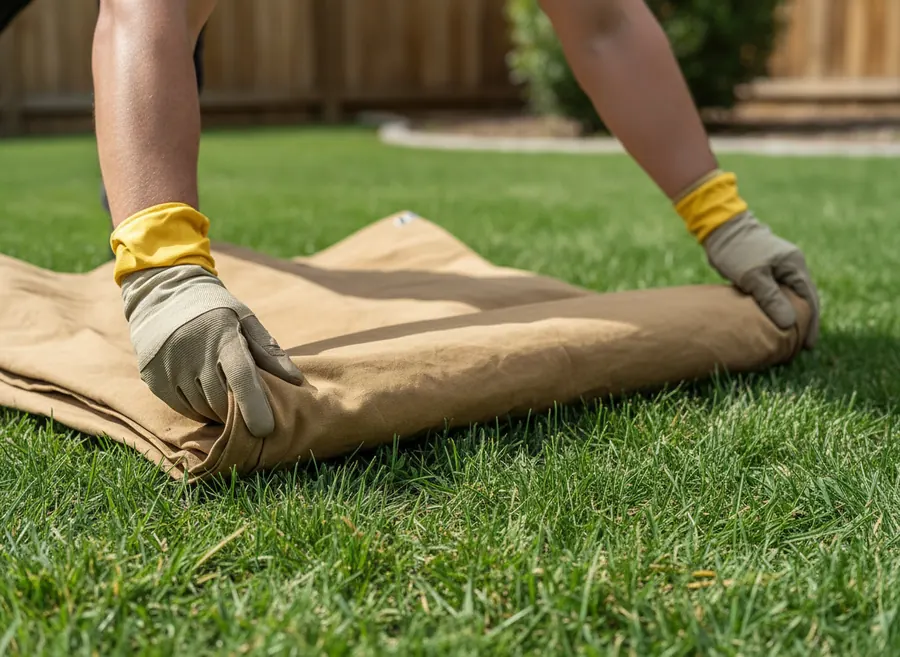
Can it be carried to the curb, and does your city collect there? Stand at the animal and settle four things. Is it on your property, or on the road or shoulder? A carcass on a public road belongs to the agency that maintains that road, and TxDOT handles dead animals on the state highway system. Is it still alive? This site does not route live-animal work. Was anyone bitten or scratched? Health and Safety Code §826.041(a) requires a report to the local rabies control authority. Then weigh the curb: a small animal in Austin or Dallas can go there under the city's own instruction quoted above, while a deer or a heavy raccoon stays where it is, and that is the request an operator takes.
Cases this page is for
- A raccoon lying in the grass by the back fence, in the open and in full view.
- An opossum on the driveway or beside the trash cans.
- A skunk in a flower bed under the front windows, with the smell already at the door.
- A deer that died inside a fenced yard and did not come off a road.
- Several carcasses after a storm or a flood, each lying in the open on one property.
What falls outside it
A carcass on a public road or shoulder goes to the agency that maintains that road, not through this site. Live animals are not routed, and Texas's statewide rabies quarantine makes it illegal to transport any live fox, skunk, coyote or raccoon (25 TAC §169.34). The remains of pets and livestock are not routed through this site, nor is a deer struck on a road. An animal under the deck or the house, in the attic or in a crawl space has its own page. A smell with no carcass in sight starts on the odor page, and a carcass sealed inside a wall is information only, in the wall article.
Access in a yard is about the gate and the ground. An operator needs a way to walk or roll to the carcass: an unlocked gate, a path around the house, and ground firm enough to carry a large animal out. Anything reachable that way, with every wall, ceiling and floor of the house left intact, is in scope. Say on the form if the gate is locked or a dog is loose.
A deer that died in the yard is lifted out whole and taken for disposal. TPWD's rule in 31 TAC §65.88 sets the lawful disposal methods for the parts of a dead deer that are moved, and the deer page sets that rule out in full. Nothing is kept.
None of the Texas statutes or state rules we reviewed sets a deadline for taking a wild animal carcass off residential property. Texas law does require a person to abate a public health nuisance on property they possess as soon as they know it exists (Health and Safety Code §341.012(a)), and it does not say at what point a carcass becomes one.
How does a yard request move?
- If you are in Austin or Dallas and the animal is small enough to move, read the city's curb instruction quoted above and decide whether that route suits you.
- Otherwise call the routing line, or send the form with the ZIP code, where in the yard the animal is and roughly how big it is.
- A form request is matched by ZIP code to an independent operator where one covers the address. A call reaches the routing line.
- The operator agrees the price and a visit time with you, lifts the carcass out, bags it and takes it away for disposal.
About this situation
Can I put a small dead animal in the trash cart?
Only where your city's own page says so. Austin Resource Recovery's page says a small dead animal such as a mouse, bird or turtle can be bagged and placed in the trash cart, and that dead animals are not accepted in the compost cart. Other cities' cart rules are not quoted on this page; ask your city before using the cart.
How does the own-land disposal exemption work for a homeowner?
It is narrow and it belongs to the individual landowner, not to an operator. Health and Safety Code §365.012(l) says the dumping offense does not apply to an individual's disposal of litter or other solid waste if the waste is generated on land the individual owns, is not generated by an activity related to a commercial purpose, the disposal occurs on land the individual owns, and the disposal is not for a commercial purpose. 30 TAC §330.13(a) adds that no permit, registration, notification or other authorization is required for up to 2,000 pounds a year of such waste disposed of on the individual's own land, provided the waste is not hazardous or industrial waste, the method complies with TCEQ's outdoor burning rules, and the disposal does not contribute to a nuisance or endanger public health or the environment; more than 2,000 pounds a year per residence is considered a nuisance. Your city may have its own rule, so check your city's code.
Should I move the animal to the curb before calling anyone?
In Austin and Dallas, moving a small animal to the curb is the route the city's own page describes, and that choice is yours. Austin Resource Recovery's own 311 close-out notes describe a yard pickup as a last resort for an animal too large to move, with someone at home. For a large animal, or in a city whose page is not quoted here, leave it where it lies and send the form; the operator does the lifting.
Why do the Harris and Montgomery County pages talk only about roads?
Because that is what those pages cover. Harris County Precinct 4's FAQ answers a dead animal on a county right-of-way or roadway with a service request. Montgomery County Precinct 2 says the Commissioner's office is responsible for the county roads and easements in the precinct and lists dead animals among the requests that get a work order; Precinct 3 lists dead tree and dead animal removal among its services. The pages we reviewed describe road and right-of-way work and do not describe private yards. That describes the pages, not what either county will or will not do.
By animal
- Dead animal removalPickup and disposal of a carcass lying where it can be reached on private property, by an independent operator where one covers the address.
- Under the house or deckA carcass under a deck, porch, shed or raised house, reached through the gap or skirting opening the structure already has, by an independent operator where one covers the address.
- Dead deerA deer found dead on a lawn, lot or fenced yard. Taken for disposal under TPWD's carcass rule; a deer on a road is not routed here.
- Smell, nothing visibleThe smell is certain and the carcass is not in sight. This page sorts a reachable carcass, which an operator can take, from a sealed-cavity smell, which is information only.
- CostThe five things that move the price of a carcass removal on private property, with no figures, because the quote comes from the independent operator who covers the address.
Whose job is it? Who removes it · Disposal rules · Dead deer
By area: Harris County · Montgomery County · Dallas · Austin